KALOYAN YORDANOV
"Simplicity is the ultimate sophistication."
Leonardo da Vinci
Annex to the National Building Museum ARPL 602 Comprehensive Building Design Studio Andrew Cocke, Principal, Here Design
Florida Ave
Introduction
We are currently awash in a wave if extraordinary architectural progress, precipitated by an unprecedented flood of technological advancement and mounting concerns about climate change. We are likely to see architectural forms change radically over the next few generations as architects struggle to assimilate this technological progress in the built environment and react to the growing challenges of energy and water scarcity and global climate change.
This studio seeks to answer the big question of how architecture changes in response to technology, and how architects can harness these changes to make better buildings.
"It is very easy to be different, but very difficut to be better"
Jonathan Ive


TEAM "CTRL Z"

Daniel Bertuso
B.S. in Business, MArch
Project Management, Design Development, Construction Docs, Rendering Assistance, Diagraming

Zainab Behbehani
B.A. in Interior Design, MArch
Design Development, Interior Design, Construction Docs, Rendering - Main,


Background
Opened in 1985 as a private, non-profit museum dedicated to the building arts, the National Building Museum (NBM) is one of only four major museums in the USA dedicated to architecure and allied arts. The institution was concieved as "a museum devoted to architecture, landscape architecture, engineering, construction, urban planning, historic preservation, and the many fields of design and development that compose our built environment". In the early thirty years since its opening, architecture and its allied arts have been transformed by cultural, social, economic, and technological forces. While NBM is in no danger of outgrowing its vast home, architectural innovations as well as the evolution of the very idea of museum have inspired new thinking about the logical extension of the museum's mission: the annex would be not merely a repository for architectural ideas, but a public laboratory for the advancement of the art and science of building.


Mike Boyd
B.S. in Politic Science, MArch
Design Development, Construction Docs, BIM Coordinator, Construction, Physical Models (Details)
Christian Chute
Master's in Decorative Arts, MArch, MSSD
Design Development, Construction Docs, Diagraming Advanced Fabrication,

Kaloyan Yordanov
B.S. in Urban Planning, March,
Real Estate Development
Design Development, Construction Docs, Sustainable Studies,, Physical Modeling, Rendering Assistant


Concept
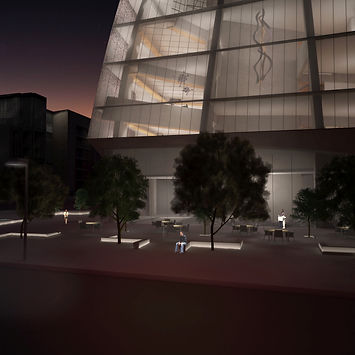
The Annex to NBM has a dynamic form that generates motion, a "turning". A turning that visually connects the Annex with NBM, and also symbolizes a turning back to the past and learning from it.
This high performance building has a main goal to become a symbol that inspires the new trends in architecture. It shows that sustainability and beauty should not be separate. It proves that a building could be green without extensive exposure of green roofs and solar panels. It gives another prospective for the future "Green Building" design. Currently we start to see alienation between form and function driven mainly by the idea that high performance buildings should look like living machines. With our design we try to prove that sustainability and architecture are inseparable and should not harm each other.
Sustainable Strategies
-
Natural Light
We felt that programmatically it was imperative to open the building to the pedestrian flow from Chinatown and the Mall. The orientation of the facade allows for natural light to stream into the Southern side of the building while the gallery spaces are along the North to allow for controlled lighting. The initial massing allows the light to penetrate deeper during the winter months and keeps the summer light within the first few feet of the spaces.
-
Natural Ventilation
Operable windows in the northern facade allow cool natural air into the building. The air is moved through the building by a negative pressure created in the southern double curtainwall system.
-
Energy Savings
During the corner seasons, using natural ventilation integrated along with a capillary mat system greatly reduces energy costs. In the winter the southern orientation of the double curtian wall creates a heat sink that acts like a thermal blanket for the building.

Winter Solstice
Summer Solstice
Winter Winds
Summer Winds
CFD Studies
Ground Floor
Basement
Second Floor
Third Floor
Fourth Floor
Fifth Floor
Roof Deck
South Facade
Double Curtan Wall & Plenum Detail


Main Entry
Storefront & Amphitheatre Detail
Rainscreen Detail
North Facade